

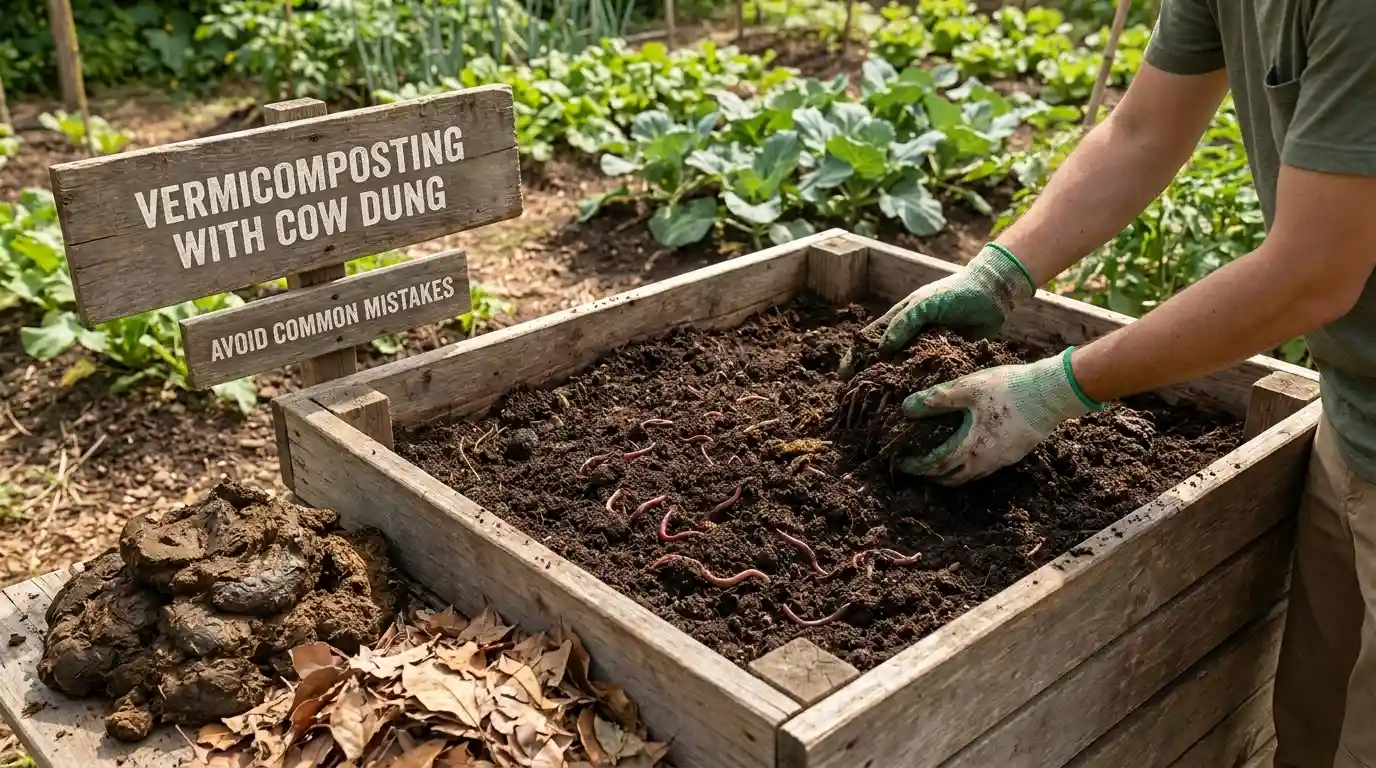

Most people kill their worm bin in week two.
Not because vermicomposting is hard. Because they treat fresh cow dung like it’s ready to use straight from the field.
It’s not. And that one mistake ends more worm bins than heat, pests, and bad drainage combined.
1. Using Fresh Dung Instead of Aged Dung
Fresh cow dung is hot. Literally – it heats up as it decomposes, and it releases ammonia while it does. Drop your worms into that, and they won’t crawl away. They can’t. They’ll die in the bin, right where you put them.
The fix is dull but non-negotiable: age the dung for 15 to 20 days before it goes anywhere near your worms. Spread it out, let it cool, let the smell mellow from sharp to earthy. Earthy means safe. Sharp means wait.
2. Getting the Moisture Wrong
Old way: dump dung in, add water until it looks “compost-y,” walk away.
New way: squeeze a handful. If water drips out, it’s too wet. If it crumbles like dry sand, it’s too dry.
You want the texture of a wrung-out sponge. That’s it.
Too wet and the bin turns anaerobic – you’ll know because it starts to smell like a drain, not soil. Too dry and your worms migrate to the one damp corner of the bin and stay there, refusing to work the rest of the pile.
3. Overloading the Bin Too Fast
Here’s the scenario: you get excited, you have a sack of aged dung, so you dump the whole thing in on day one. Three days later, the bin is a mess – smells off, worms are gone from the top layer, temperature’s climbing.
Worms process roughly their own body weight in food per day. Not per week. Per day. A bin with 500g of worms can’t absorb 5kg of dung overnight.
Feed in thin layers. Add more only after the previous layer is mostly gone. Slow is the whole method.
4. Ignoring Bedding
Cow dung alone is not a bin. Worms need dry bedding – coco peat, shredded cardboard, dry leaves – mixed in underneath and around the dung layers. Skip the bedding and you get a dense, airless block that suffocates the pile from the inside.
Bedding does the boring job of letting air move. No air, no worms. Simple as that.
5. What Vermicomposting With Cow Dung Is Actually Good At
Done right, this combination is hard to beat. Cow dung already carries a strong microbial base – worms just accelerate what’s already happening. You get compost in 60 to 90 days instead of the 6+ months plain composting takes.
Cornell’s worm composting basics guide explains the same core mechanism – worms passing organic matter through their bodies to turn it into nutrient-rich castings.
It also scales down well. You don’t need a farm. A 2×2 foot bin on a balcony handles a small kitchen garden’s worth of compost, easily.
6. Where It Still Goes Wrong
Even aged, well-bedded, properly fed bins fail sometimes. Pests – ants, especially – show up if the bin ever fully dries out. If you’re instead seeing tiny pale bugs multiplying on wet surfaces, that’s usually white mites or springtails, and it’s worth knowing which one you’re looking at before you react.
Temperature swings in peak summer can push worms to the bottom or out entirely if the bin sits in direct sun. And if you’ve ever used pesticide-treated feed on the cattle, that residue can carry into the dung and harm the worm population.
Not common, but worth checking if your worms keep vanishing for no clear reason.
Vermicomposting with cow dung isn’t fragile. It’s just specific. Age the dung, check the moisture, feed slow, bed it right – and the mistakes above simply don’t happen.
Start with a small bin. Get the ratios right at a small scale before you try to scale it up. That’s the whole game.

Leave a Comment