

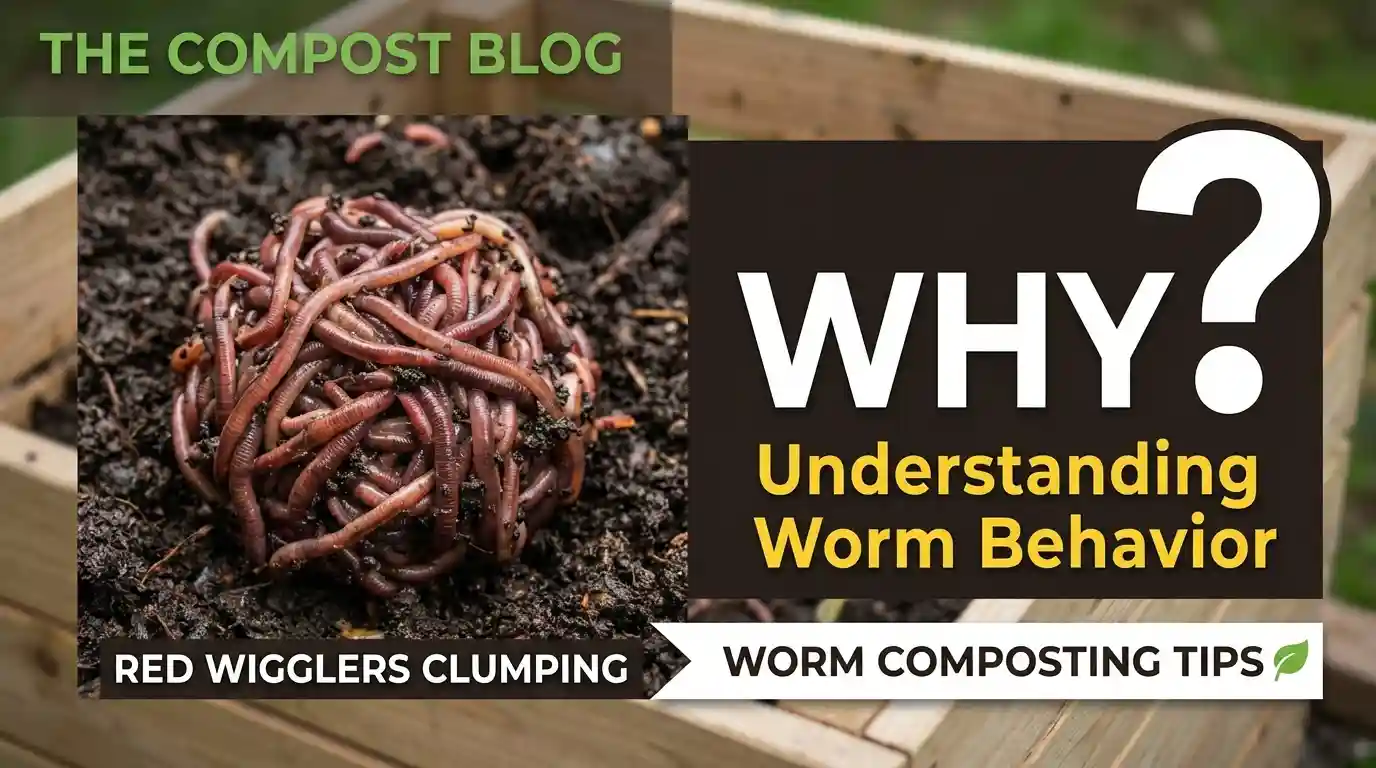

“A worm’s behavior is the ultimate dashboard for your bin’s health.”
Opening your vermicompost bin to find a massive, writhing, tangled ball of worms can be a terrifying experience for a beginner.
It looks like a scene from an alien movie. Your first instinct is usually panic: Are they dying? Is the bin ruined? Do I need to separate them?
In the worm farming community, this phenomenon is simply called “Worm Balling.” Before you start pulling them apart, you need to understand that worms clump together for two entirely opposite reasons: Supreme Happiness or Extreme Stress.
This diagnostic protocol will help you instantly figure out whether your worms are throwing a party, or if they are executing a desperate survival tactic.
Phase 1: The Diagnostic Test (Good Ball vs. Bad Ball)
To figure out what is happening, do not touch the worms yet. Instead, look at their environment using this 10-second checklist:
1. Where is the ball located?
- Buried in the bedding/under food: If you dug into the compost and found the ball wrapped around an avocado shell or a piece of melon, relax. This is a healthy feeding and mating swarm.
- On the surface, in the corners, or on the lid: If the ball is exposed on the top surface, clinging to the walls, or huddling in the very corner of the bin, alert. This is a stress ball. They are trying to escape the bedding.
2. What does the bin smell like?
- Like a forest after rain: Healthy. The environment is fine.
- Like vinegar, sulfur (rotten eggs), or ammonia: Toxic. The bedding has gone anaerobic or acidic, and the worms are huddling together to survive the chemical burn.
Phase 2: Scenario A — The “Feeding & Mating” Ball (Healthy)
If your bin smells earthy and the ball was hidden under the surface, congratulations! Your bin is thriving.
Red wigglers are highly social feeders. When you drop a high-value, water-rich food item into the bin (like pumpkin, melon rinds, or avocado), the worms will swarm it. They excrete enzymes together to break the food down faster.
While they are swarming the food, the close proximity makes it the perfect time for them to breed. A “mating knot” is a sign of a robust, multiplying population.
In fact, as the Rodale Institute notes in their vermicomposting research, red wigglers are communal by nature and under ideal conditions their population can double approximately every two months – and a dense feeding-and-mating swarm like this is exactly what drives that growth.
What you should do: Leave them alone! Cover them back up with damp cardboard and let them finish their feast.
Phase 3: Scenario B — The “Stress Ball” (Emergency)
If the ball of worms is sitting on the surface, on the walls, or if the bin smells bad, you have an emergency.
When red wigglers are exposed to a toxic environment, their skin begins to burn. To protect themselves, they intertwine their bodies to share moisture and minimize the amount of skin exposed to the toxic bedding. They huddle in the corners because they are trying to climb out.
Here are the 3 main culprits for a Stress Ball:
Culprit 1: Protein Poisoning & Acidosis (Too Much Food)
You overfed them. The food is rotting faster than the worms can eat it, creating a highly acidic sludge (fermentation). The acid literally burns their sensitive skin.
In severe cases, this same acidic environment can escalate beyond a stress ball — causing individual worms to develop a condition called String of Pearls” (Protein Poisoning), where internal fermentation ruptures their bodies from the inside out. It is the grimmest possible outcome of an overfed bin.
- Symptom: A sharp vinegar or alcohol smell.
Culprit 2: Anaerobic Conditions (Lack of Oxygen)
The bin is too wet, and the drainage holes are blocked. The bedding has compacted into mud, suffocating the worms.
- Symptom: A foul, rotten egg or sewage smell. Puddles of liquid at the bottom.
Culprit 3: The “Hot” Compost Effect
You added too much nitrogen (green scraps, grass clippings, or fresh manure). The bin has started “hot composting,” and the temperature inside has spiked to over 90°F (32°C). The worms are clumping at the edges to escape the heat.
A stress ball that goes unaddressed for more than 24–48 hours often graduates to a worse problem: worms begin abandoning the bin entirely, disappearing into the surrounding environment.
If you open your bin after a stress ball event and find fewer worms than before, read Worms Disappeared from Worm Farm? 6 Reasons & How to Fix It — it covers exactly what happens when stress crosses the point of no return.
Phase 4: The 5-Minute Rescue Protocol
If you diagnosed a Stress Ball, you need to act immediately to save your colony. Follow these three steps:
Step 1: Remove the Lid and Aerate
Take the lid off to let toxic gases (like ammonia) escape. Gently take a hand fork or your gloved hands and fluff the bedding. Do not chop aggressively; just lift the compacted soil to let oxygen reach the bottom.
Step 2: The Carbon Buffer (Dry the Bin)
Stop feeding immediately. Grab a massive handful of dry, shredded cardboard or dry newspaper and mix it deeply into the bin. This dry carbon will soak up the excess toxic moisture and create air pockets.
Step 3: Neutralize the Acid
If the bin smells sour, sprinkle a generous handful of pulverized eggshells or agricultural lime (never hydrated lime) over the surface. This acts as a buffer, instantly neutralizing the acid and soothing the worms’ skin.
Leave the lid off and keep the bin under a bright light for 24 hours. The light will force the worms to stay down, and the dry bedding will stabilize the environment.
Frequently Asked Questions (FAQs)
Q1: Should I manually pull the ball of worms apart?
Ans: No. Pulling them apart can tear their delicate bodies. Fix the environment using the rescue protocol above, and the worms will naturally untangle themselves and return to the bedding within a few hours.
Q2: I just bought my worms yesterday and they are balling up. Why?
Ans: This is normal “Transit Shock.” Being shipped in a box is stressful. When introduced to a new bin, they will often clump together out of fear and confusion. Keep a light on over the bin for the first two nights, and they will eventually explore their new home.
Q3: Can worms suffocate if the ball is too tight?
Ans: No. Worms breathe through their skin by absorbing dissolved oxygen from moisture. A tight ball actually helps them share that crucial moisture when the surrounding environment becomes dangerously dry or toxic.

Leave a Comment