

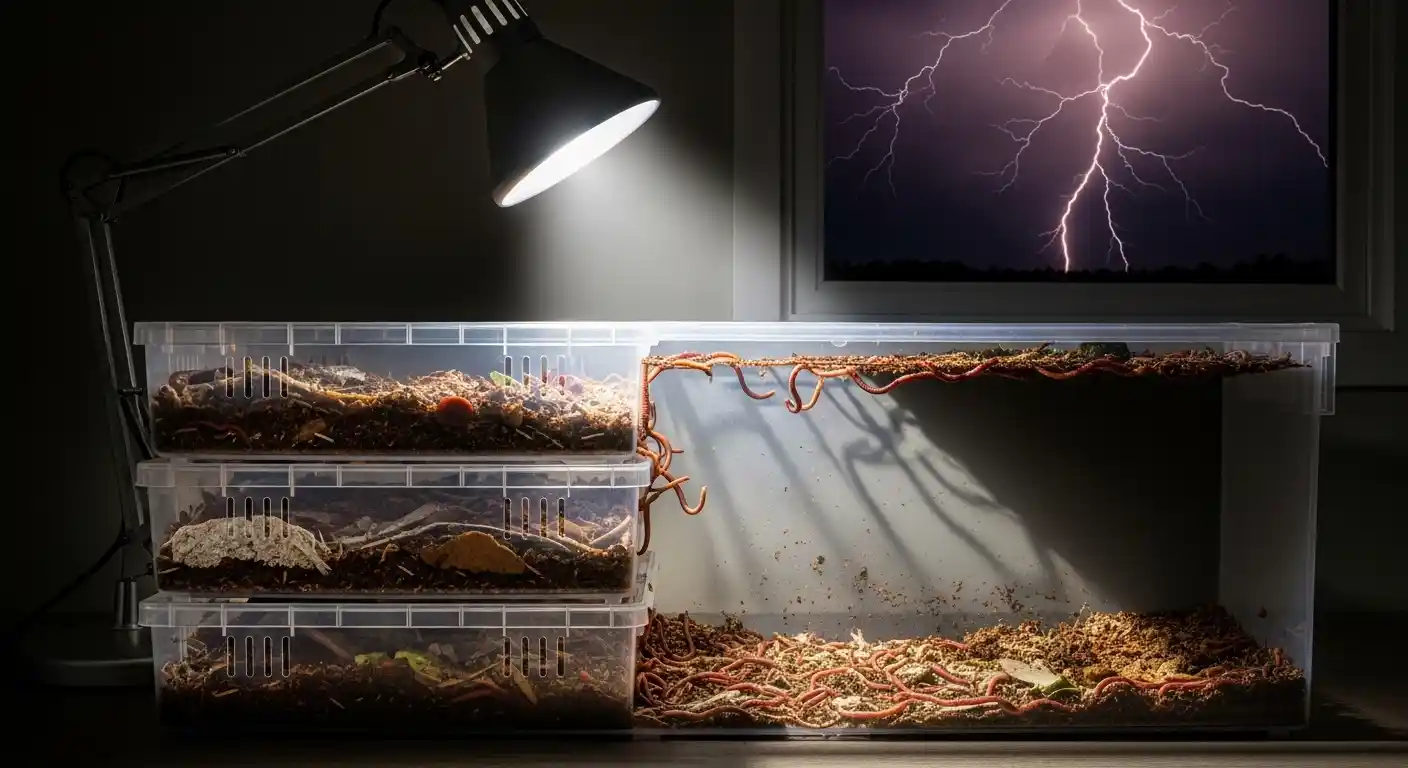

You’re sitting on your porch, the sky is turning that eerie shade of “storm-cloud green,” and you haven’t felt a drop of rain yet.
But inside your house – or out in the garage—your worm bin is already in a state of high alert.
If you’ve noticed your worms climbing the walls before the first lightning strike, you aren’t imagining things.
You’ve just witnessed one of nature’s most sensitive barometers in action. While most guides tell you to “check the moisture,” they miss the invisible force driving your worms upward: Atmospheric Pressure.
Quick Answer: The “Storm Sense”
- The Science: Worms have specialized receptors (prosternal organs) that detect drops in barometric pressure.
- The Instinct: A pressure drop signals a “migration window” where the ground will be wet enough for them to travel without drying out.
- The Problem: In a plastic bin, this “travel window” leads to a dead end at the lid.
- The 5-Minute Fix: Turn on a bright light above the bin 2 hours before a predicted storm to override their migration instinct.
Myth-Busting: “They only move once they get wet”
Many vermicomposters believe that worms only climb the walls because the humidity has spiked or the bedding is too damp.
The Truth: Research shows that composting worms (especially Eisenia fetida and Perionyx excavatus) react to the pressure drop that precedes a storm.
In many cases, the worms are already on the walls while the air is still bone-dry. They aren’t escaping the wet; they are anticipating the wet.
Pro Tip: If your worms are on the walls but the bedding feels perfect, don’t add dry bedding yet—you’ll just mess up your moisture levels for a “problem” that is actually atmospheric.
3 Reasons Why Pressure Changes Affect Your Bin
1. The “Safety Window” Instinct
In the wild, worms are confined to the moist earth. Moving across the surface is usually a death sentence (sunlight and predators). However, a rapid drop in barometric pressure tells the worm that a soaking rain is imminent.
- The Trigger: A drop below 29.92 inHg (standard atmospheric pressure).
- The Result: Worms move to the surface to find mates or colonize new areas.
- The Fix: Keep the bin lid tightly secured but increase the light exposure in the room.
2. Oxygen Displacement in the Bedding
As barometric pressure drops, gases trapped within the bedding (like CO2) can actually expand slightly.
- The Trigger: Lower pressure allows air “pockets” to shift.
- Signs: You might notice a slight “musty” smell right before a storm that wasn’t there before.
- The Fix: Gently fluff the bedding with a hand rake to release trapped gases before the storm hits.
3. Humidity Trapping (The Greenhouse Effect)
Low-pressure systems often bring higher ambient humidity. If your bin is plastic, it becomes a sealed greenhouse.
- The Trigger: High dew points making the plastic walls “sticky.”
- Signs: You’ll see the “Condensation Highway” we discussed in our Guide to Worms and Rain.
- The Fix: Use a “Breather Lid” (a lid with a large cutout covered in fine mesh) during storm season.
5-Minute Diagnosis: Is it a Storm or a Stressor?
How do you know if your worms are “Storm Riding” or actually dying from a bin issue?
| Observation | Storm Behavior | System Stress (pH/Heat) |
| Movement Pattern | Individual worms spread out | Clumped in “balls” or at the bottom |
| Timing | Correlates with weather reports | Random or after a big feeding |
| Smell | Earthy / Normal | Sour, Ammonia, or Rotten |
| Worm Health | Plump and active | Pink, “stringy,” or lethargic |
How to “Storm-Proof” Your Bin Tonight
If the weather app is flashing a thunderstorm warning, do these three things:
- The “Lid Gap” Technique: Prop the lid open by just half an inch. This equalizes the pressure and humidity inside the bin faster, reducing the “sweat” on the walls.
- The Light Shield: Worms are photophobic. A simple LED light strip above the bin acts as an “invisible lid.” They will sense the pressure, try to climb, see the light, and dive back down.
- The Carbon Cap: Lay a single sheet of dry, brown paper bag over the bedding. This absorbs the immediate humidity spike that occurs as the pressure drops.
FAQ: Weather and Worms
Do indoor worms really feel the weather?
Absolutely. Barometric pressure penetrates walls. Your worms “feel” the storm exactly like you might feel a “sinus headache” when the pressure drops.
My worms only climb during thunderstorms. Why?
Thunderstorms are usually “Low Pressure Cells.” The more rapid the drop in pressure, the more frantic the climbing behavior.
Should I feed them less during rainy weeks?
Yes. High humidity reduces evaporation, which means the bin stays wetter longer. Overfeeding during a rainy week is the #1 cause of “Sour Bin Syndrome.”
Summary: Relax, It’s Just Physics
If your bin is healthy and your worms are simply “wall-riding” before a storm, you are doing a great job. It means your worms are healthy enough to respond to their natural instincts.

Leave a Comment