
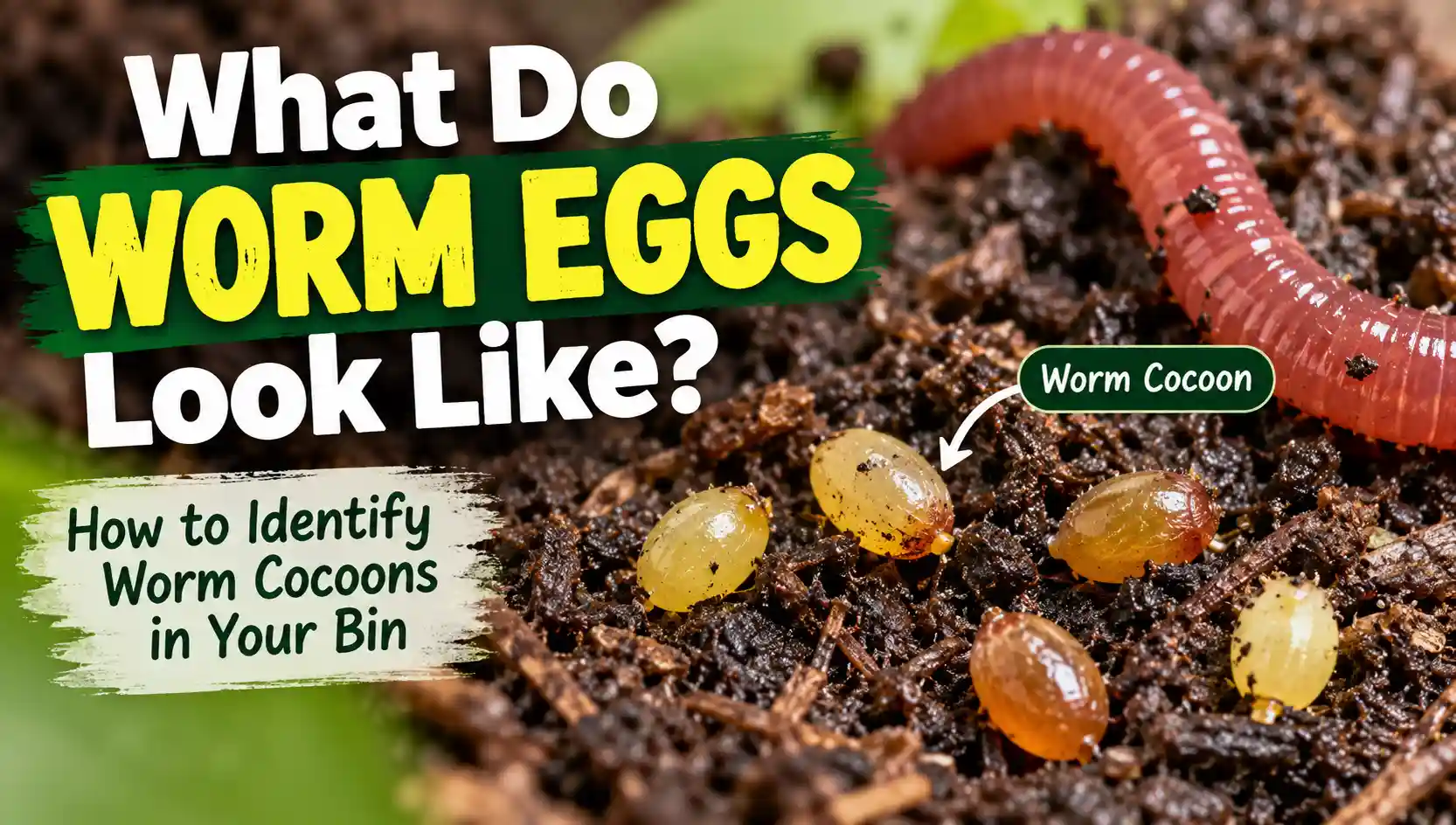

If you are seeing tiny yellow, brown, or reddish objects in your worm bin, you may be wondering, what do worm eggs look like?
For composting worms such as red wigglers, you usually will not see individual eggs. The eggs develop inside a small protective cocoon, also called an egg capsule.
Red wiggler cocoons are tiny, usually smaller than a grain of rice, and can have a rounded or lemon-like shape. Their color may range from pale yellow or golden to darker brown or reddish shades as they develop.
Finding these cocoons in your worm bin is generally a good sign. It means your mature worms are reproducing.
What Do Worm Eggs Look Like?
Worm eggs are not normally visible as separate individual eggs in a vermicompost bin.
Instead, what you are likely to notice is a worm cocoon. The cocoon is a small capsule produced by the worm that protects the developing young worms.
For red wigglers, Eisenia fetida, the cocoon is typically:
| Feature | What it looks like |
|---|---|
| Shape | Small, rounded or lemon-shaped capsule |
| Size | Very small, generally smaller than a grain of rice |
| Color | Yellow, golden, brown, reddish, or darker as it develops |
| Location | Often found in the bedding or near the surface |
| Contents | Developing young worms |
| Texture | Firm capsule rather than soft food material |
The exact appearance can vary with worm species and the stage of development.
Worm Eggs vs. Worm Cocoons: What Are You Actually Seeing?
This distinction causes a lot of confusion.
A worm egg is the reproductive cell produced by the worm. A cocoon is the protective capsule in which the developing embryos are contained.
So when someone asks, “What do worm eggs look like?”, the practical answer for a worm farmer is usually:
You are looking for worm cocoons, not individual eggs.
Red wigglers are hermaphroditic, meaning each mature worm has male and female reproductive organs. However, they still mate with another worm. During reproduction, the clitellum produces material that eventually forms the cocoon.
What Do Red Wiggler Cocoons Look Like?
Red wigglers are among the most commonly used worms for vermicomposting.
Their cocoons are easy to overlook because they are so small.
1. Shape
A healthy red wiggler cocoon is generally compact and rounded to lemon-shaped rather than long and worm-like.
Some may look almost like tiny seeds when mixed into bedding.
Because cocoons are small, they can easily be mistaken for pieces of organic material.
2. Size
A red wiggler cocoon is smaller than a grain of rice according to Oregon State University Extension.
That means you should not expect to find something large enough to immediately identify from several feet away.
Look closely through the bedding, especially when harvesting.
3. Color
Cocoons can vary in color.
You may notice:
- Pale yellow
- Golden yellow
- Tan
- Brown
- Reddish or darker shades
Color alone is not enough for identification because cocoons change as they develop and their appearance can vary.
A small, firm, capsule-like object that looks different from surrounding food scraps or bedding is worth examining more closely.
What Is Inside a Worm Cocoon?
A worm cocoon contains developing young worms.
The number of hatchlings can vary. Oregon State University reports that red wiggler cocoons can hatch two to five young worms, with hatching occurring in about three weeks under suitable conditions.
The young worms do not look like miniature dark-red adult worms at first.
Newly hatched red wigglers are generally very pale or whitish, with a pinkish appearance that becomes darker as they mature.
This is one reason beginners sometimes miss baby worms completely. They blend into light-colored bedding.
Where Will You Find Worm Cocoons in a Worm Bin?
Red wigglers are surface-dwelling composting worms. They tend to live in the upper layers of organic material rather than deep underground like burrowing earthworms.
Cocoons can therefore be found throughout the bedding, particularly around active worm areas.
You may notice more cocoons:
- Near areas where mature worms are feeding
- In moist bedding
- Around decomposing organic material
- Close to the surface
- Mixed into worm castings
Do not expect every cocoon to be sitting visibly on top of the bedding.
Many will be buried or hidden among shredded paper, cardboard, food residue, and castings.
When Do Worm Cocoons Hatch?
Under suitable conditions, red wiggler cocoons can hatch in roughly three weeks.
However, this should not be treated as an exact countdown.
Temperature, moisture, species, and overall bin conditions can affect worm activity and development.
Temperature is particularly important. Oklahoma State University notes that red wigglers grow best around 65°F to 85°F (19°C to 29°C), while other extension sources give somewhat different preferred ranges.
The practical lesson is simple:
Healthy, stable bin conditions matter more than trying to force cocoons to hatch quickly.
What Happens When a Cocoon Hatches?
The young worms emerge from the cocoon and begin living in the bedding.
At first, they can be surprisingly difficult to see.
New hatchlings are much lighter than mature worms. As they feed and grow, their bodies gradually become more recognizable.
You may suddenly notice many small, thin worms in the bin several weeks after previously seeing cocoons.
That is normal.
You do not need to dig through the bin looking for every hatchling. A stable environment with appropriate food, moisture, oxygen, and protection from extreme temperatures is more important.
How Temperature and Moisture Affect Worm Cocoons
Cocoons are more resistant to unfavorable conditions than active worms, but that does not mean they can survive anything.
Your goal should be to maintain a stable environment for the entire worm colony.
Keep the bedding moist
Red wigglers require moisture because they breathe through their skin.
Oklahoma State University recommends moisture in the general range of 70% to 85% for composting worms.
For a home worm bin, you do not need to measure humidity with laboratory equipment.
The classic practical test is to make the bedding moist but not waterlogged.
Think of a wrung-out sponge.
Avoid overheating
High temperatures can become dangerous for composting worms.
Oklahoma State University notes that prolonged exposure to high temperatures can kill red wigglers, while cooler conditions slow their activity.
That makes direct summer sun particularly risky for outdoor bins.
Keep the bin shaded and well ventilated, especially during hot weather.
How to Protect Worm Cocoons During Harvesting
If you are harvesting worm castings, you will almost certainly encounter some cocoons.
Do not panic if a few end up in your finished material.
Instead, inspect the material before removing it from the worm system.
You can:
- Gently sift the castings.
- Look for small yellow, brown, or reddish capsules.
- Return recognizable cocoons to the worm bin.
- Place them into moist bedding.
- Avoid crushing or drying them out.
The direct competitor also recommends returning cocoons found during harvesting to the worm farm, particularly when manually sorting or sifting castings.
There is no need to spend hours trying to recover every single cocoon. A few will inevitably be lost during harvesting.
Worm Cocoon vs. Other Things in Your Compost Bin
One of the biggest beginner mistakes is assuming that every small yellow or brown object is a worm cocoon.
Your worm bin can contain many other materials and organisms.
For example, you may see:
- Food particles
- Small pieces of cardboard
- Seeds
- Root fragments
- Mites
- Springtails
- Pot worms
- Other decomposer organisms
NC State Extension notes that mites, springtails, pot worms, pill bugs, molds, and other organisms can naturally appear in worm bins and are not automatically signs of a problem.
How can you tell a cocoon from random material?
Look for a combination of characteristics rather than relying on color alone.
A suspected cocoon is more likely to be:
- Uniform in shape
- Small and capsule-like
- Firm rather than mushy
- Yellow, amber, brown, or reddish
- Distinct from ordinary food residue
- Found in bedding where worms are active
When you are unsure, leave it alone rather than crushing it.
Are Worm Cocoons a Good Sign?
Yes. Seeing cocoons generally indicates that mature worms are successfully reproducing.
For a new worm bin, this can be one of the clearest signs that the worms are comfortable enough to reproduce.
Red wigglers are particularly well suited to vermicomposting because they live in rich organic material, tolerate confinement, and reproduce relatively quickly under suitable conditions.
A growing number of cocoons does not mean you should immediately increase feeding.
This is an important beginner mistake.
Worm population, available food, bedding, temperature, moisture, and bin size all need to remain balanced. If you notice an abrupt breeding spike rather than steady reproduction, this “good sign” in your worm bin may actually be a warning that your worms are stressed by overcrowding or rising acidity.
Why Aren’t My Worms Producing Cocoons?
If you have had your worms for a while and cannot find any cocoons, do not immediately assume something is wrong.
Possible explanations include:
The worms are too young
Young worms need time to mature before they can reproduce.
The conditions are unsuitable
Extreme temperatures, overly wet bedding, poor ventilation, or very dry conditions can interfere with normal worm activity.
You are simply not seeing them
Cocoons are tiny and can be hidden throughout the bedding.
You have the wrong type of worm
Not every earthworm is equally suited to vermicomposting.
Red wigglers, especially Eisenia fetida, are widely recommended for worm bins because they are surface-dwelling composting worms. Common deep-burrowing earthworms are not the same thing.
What Do Baby Worms Look Like?
Newly hatched worms can look very different from the mature worms you bought.
They may appear:
- Very thin
- Pale or almost transparent
- Whitish
- Pinkish
- Much smaller than adult worms
Oregon State University describes young red wigglers as whitish with a pink central area associated with their blood vessels.
As they grow, they become darker and develop the familiar appearance of adult red wigglers. Because newly hatched worms are pale and threadlike, beginners often confuse them with tiny white worms in compost such as pot worms, which are harmless decomposers rather than baby red wigglers.
Do Worm Cocoons Need Special Care?
Usually, no.
You do not need to remove cocoons from the bin and place them in a separate container.
The safest approach is to maintain good conditions in the main worm bin.
Focus on:
- Moist but not flooded bedding
- Good airflow
- Shade
- Moderate temperatures
- Adequate bedding
- Reasonable feeding
- Minimal unnecessary disturbance
Vermicomposting works best when the system is stable rather than constantly manipulated.
Can Worm Cocoons Survive Cold Conditions?
Cocoons can tolerate cold conditions better than active worms in some circumstances.
Oklahoma State University notes that composting worm cocoons can survive extended periods of cold and hatch when warmer conditions return.
That does not mean you should leave a worm bin exposed to extreme weather.
Protecting the overall worm habitat is still the better strategy.
Frequently Asked Questions
What do worm eggs look like?
For composting worms, what you normally see are cocoons, not individual eggs. Red wiggler cocoons are tiny, often smaller than a grain of rice, and may look yellow, golden, brown, or reddish.
Are worm eggs visible to the naked eye?
Individual eggs inside a worm cocoon are not normally visible to you as separate eggs. The visible structure is the protective cocoon.
What color are worm cocoons?
Red wiggler cocoons can appear yellow, golden, brown, or reddish. The exact color can vary with development and conditions.
How big are red wiggler cocoons?
They are very small and generally smaller than a grain of rice.
How many baby worms are in one cocoon?
The number varies, but Oregon State University reports that a red wiggler cocoon may hatch two to five young worms.
How long does it take for worm eggs to hatch?
For red wigglers, cocoons may hatch in approximately three weeks under suitable conditions. Actual timing can vary.
Should I remove worm cocoons from my compost?
No. Leave them in the worm bin. If you find cocoons during harvesting, return them to moist bedding so the young worms can develop.
Are worm cocoons a sign of a healthy worm bin?
Generally, yes. Cocoons indicate that mature worms are reproducing, although you should look at the overall condition of the bin rather than using cocoons alone as a health indicator.
Final Takeaway
When you ask “What do worm eggs look like?”, the most useful answer for a vermicompost owner is that you are looking for worm cocoons.
For red wigglers, these cocoons are tiny, usually smaller than a grain of rice, and may appear yellow, golden, brown, or reddish. They contain developing young worms and can hatch when conditions are suitable.
So the next time you spot tiny capsule-like objects in your worm bedding, do not throw them away as random debris.
They may be the next generation of worms in your bin.

Leave a Comment