

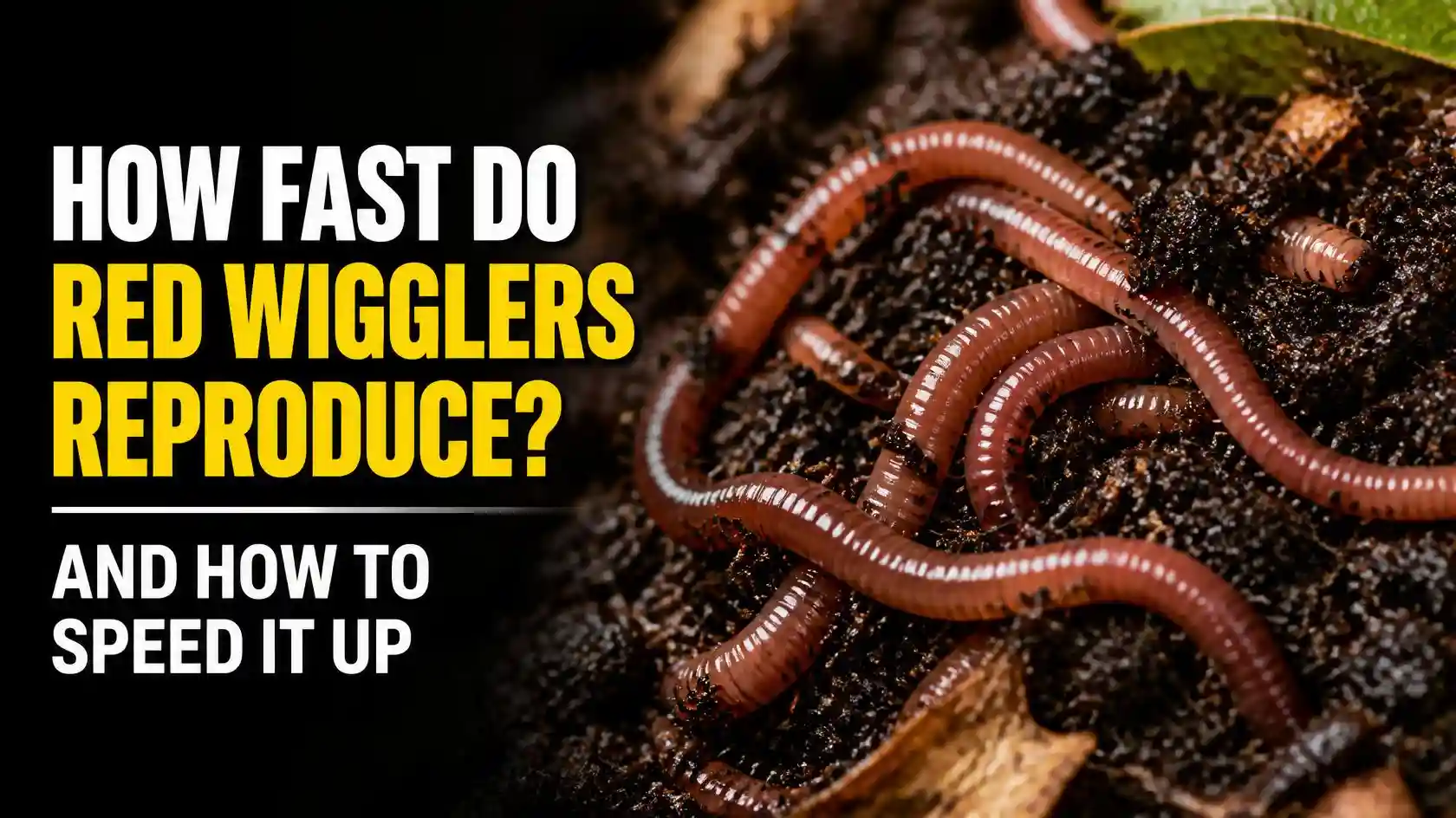

Red wigglers (Eisenia fetida) are prolific breeders – but only when conditions support it. Under ideal circumstances, a healthy worm bin can double its population every 60 to 90 days. Get the conditions wrong, and reproduction stalls for weeks.
Here’s what actually happens inside your bin, from mating to hatching, and what you can do to keep that cycle moving.
The Red Wiggler Reproduction Cycle, Explained
Red wigglers are hermaphrodites – every worm has both male and female reproductive organs. But they still need a partner. Two worms align along their bodies, exchange sperm, and each then produces a cocoon a few days later.
Each cocoon is roughly the size of a lemon seed – yellow-green when fresh, darkening to deep brown as it matures. One cocoon typically contains 2 to 4 hatchlings, though counts as high as 7 have been recorded.
How Long Does It Take for Red Wiggler Cocoons to Hatch?
At an optimal temperature of 75–80°F (24–27°C), cocoons hatch in approximately 23 days. At cooler temperatures – say, 60°F (15°C) – that timeline stretches to 60 days or longer.
A sexually mature red wiggler (usually 60–90 days old) can produce 2 to 3 cocoons per week. One worm, two cocoons weekly, three hatchlings per cocoon – the numbers compound quickly.
How Many Worms Can One Cocoon Produce?
Each cocoon yields an average of 3 juvenile worms. Here’s what that looks like at scale for a single mature worm:
| Timeframe | Cocoons Produced (per worm) | Estimated Hatchlings |
| 1 Week | 2–3 | 6–9 |
| 1 Month | 8–12 | 24–36 |
| 3 Months | 24–36 | 72–108 |
What Conditions Speed Up Red Wiggler Reproduction?
Reproduction is directly tied to environment. Four factors dominate:
Temperature
The sweet spot is 70–80°F (21–27°C). Below 50°F (10°C), reproduction effectively stops. Above 95°F (35°C), worms die. If your bin lives in a garage, check temperatures seasonally.
Moisture
Bedding should feel like a wrung-out sponge – roughly 80% moisture. Too dry and worms become stressed; too wet and the bin turns anaerobic. Both suppress cocoon production.
pH Balance
Red wigglers prefer a pH of 6.5–7.0. Heavy citrus or coffee grounds acidify the bin. Crushed eggshells or agricultural lime correct the imbalance – add sparingly.
Population Density
Overcrowding slows reproduction. Worms self-regulate when space is tight. Before your bin hits capacity, expand it or start a second one. Upgrading to a flow-through worm bin
provides continuous vertical space to accommodate expanding colonies without triggering population stalls.
How Many Red Wigglers Do You Need to Start?
For a standard 10-gallon bin, 1 pound of red wigglers (roughly 800–1,000 worms) is a solid starting point. Expect 2–3 weeks of settling before active reproduction begins.
Processing significant kitchen waste daily? Start with 2 pounds. The general rule: 1 pound of worms handles roughly half a pound of food scraps per day.
Signs Your Population Is Growing (Or Stalling)
Growth indicators:
- Tiny white thread-like juvenile worms visible in bedding
- Cocoons present when you dig through – small, brown, lemon-shaped
- Increased surface activity at feeding time
Stall indicators:
- Worms clustering at the lid or bin walls – a stress escape response
- Foul odor from anaerobic conditions (overfeeding or excess moisture)
- Pale, lethargic worms – often pH imbalance or nitrogen overload from too much protein-rich food
The Bottom Line
Red wigglers will expand their population on their own – your job is to remove the obstacles. Keep temperatures in range, maintain moisture, correct pH issues before they compound, and give the colony enough room.
Do those four things consistently and a single pound of worms becomes two pounds before the season changes.
Just starting out? Check our guide on setting up your first worm bin to make sure the fundamentals are in place before you focus on population growth.
Frequently Asked Questions
How fast do red wigglers reproduce compared to regular earthworms?
Red wigglers reproduce significantly faster than common earthworms (Lumbricus terrestris). Earthworms produce only a handful of cocoons per year; red wigglers produce several per week under optimal conditions.
Can red wigglers reproduce on their own?
No. Although each worm carries both sex organs, red wigglers must exchange sperm with a partner. Self-fertilization does not occur.
How long does it take to double a red wiggler population?
In optimal conditions – 70–80°F, correct moisture, adequate food – a population can double in 60 to 90 days.
Do red wigglers reproduce more in summer?
For temperature-controlled indoor bins, season is irrelevant. Outdoor bins will see faster reproduction in warm months, provided the bin doesn’t overheat above 95°F.
What stops red wiggler reproduction?
Cold below 50°F, heat above 95°F, acidic pH, waterlogged bedding, and overcrowding all suppress or halt reproduction.
How do I know if my red wigglers are mating?
Mating worms lie parallel, connected at their clitella – the raised band near their mid-section. The exchange takes 2–3 hours.

Leave a Comment