

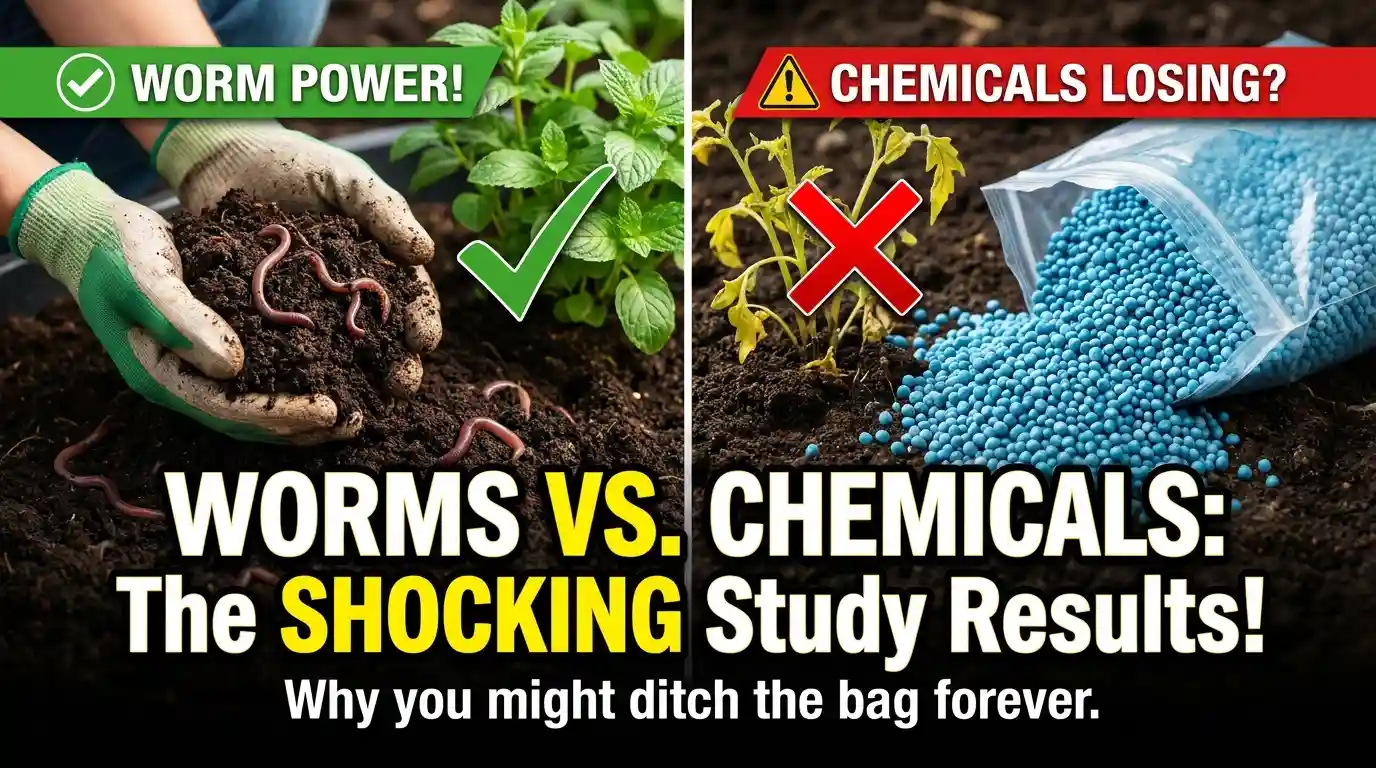

You’ve probably heard that worm castings are “good for plants.” But good compared to what? That vague claim is everywhere in the composting world – and it doesn’t mean much without a baseline.
Now there’s a baseline. And the results are harder to ignore than you’d expect.
Researchers at Ohio State University, led by soil scientist Dr. Clive Edwards, spent years comparing the effects of vermicompost – the technical name for worm castings – against standard chemical fertilisers on multiple plant species. What they found didn’t just confirm that castings work. It showed how they work, and why no synthetic fertiliser can fully replicate it.
What the Research Actually Found
In a series of controlled trials published in Pedobiologia and Bioresource Technology, Edwards and his team grew tomatoes, peppers, and strawberries using vermicompost, synthetic NPK fertilisers, and a control group with no amendments.
The plants grown in vermicompost-supplemented soil consistently outperformed those in chemically fertilised plots – and they did it using less material. At just 10–20% vermicompost by volume mixed into growing media, plant biomass, root development, and fruit yield exceeded what the chemical group produced at full application rates.
Two findings stood out most:
- Germination rates were significantly higher in vermicompost-treated seeds – some trials showed a 25–30% improvement over chemical-only conditions
- Root mass in vermicompost plots was notably denser, which matters enormously for drought resilience and long-term plant health
These weren’t marginal differences. They were consistent, reproducible, and observed across different plant species. A 2019 meta-analysis covering over 20 years of vermicompost research found average increases of 26% in commercial yield and 57% in root biomass compared to non-vermicompost treatments — confirming these results aren’t isolated to a single lab.
It’s Not Just Nutrients – That’s the Part Most People Miss
Here’s what chemical fertilisers can never replicate, no matter how balanced their NPK ratio is.
Worm castings contain plant growth regulators – specifically auxins, cytokinins, and gibberellins – that are produced naturally as organic matter moves through a worm’s gut. These compounds directly influence how plants develop at a cellular level. They signal roots to grow, stems to strengthen, and seeds to germinate faster.
No bag of synthetic fertiliser contains these. That’s not a marketing claim. It’s biochemistry.
Beyond that, a single gram of quality worm castings contains anywhere from 100 million to 1 billion beneficial microbial organisms, according to research from Cornell University’s Department of Crop and Soil Sciences.
This microbial population actively breaks down soil minerals into plant-available forms, suppresses pathogenic fungi, and builds the kind of soil structure that retains moisture without waterlogging.
A chemical fertiliser feeds the plant. Worm castings feed the system the plant lives in.
The Part the Study Didn’t Celebrate – But You Should Know
The research also showed something that doesn’t make it into most summaries.
Worm castings underperformed chemical fertilisers in one specific scenario: fast, short-cycle crops grown in sterile, inert growing media with no existing soil biology. When there’s nothing alive in the soil to begin with, castings release their nutrients more slowly, and synthetic fertilisers – being immediately soluble – can push plants faster in the first few weeks.
So if you’re growing microgreens indoors in a soilless medium on a tight timeline, straight castings may not be the fastest option at the start.
But in any garden setting with real soil – even degraded, compacted, or depleted soil – castings win. Because they’re not just feeding the plant. They’re rebuilding what’s broken.
How to Use This Research in Your Garden
The study’s practical takeaway isn’t “replace all your fertiliser immediately.” It’s more useful than that.
Start with a 15–20% castings mix by volume when transplanting seedlings or starting seeds. This is the rate where the research consistently shows the biggest performance gap over chemical alternatives.
For established beds, a top-dressing of 1–2cm worked into the surface once per season outperforms most mid-season chemical feeds in long-term soil health metrics.
If you’re using chemical fertiliser currently, you don’t have to quit cold turkey. The science suggests a transitional approach – reducing synthetic inputs gradually while building soil biology with castings – leads to better results than switching overnight on depleted ground.
Knowing how to maintain a vermicompost heap properly is what separates average castings from the high-performance output the research was actually testing.
The Bottom Line
Worm castings don’t just match chemical fertilisers. In soil-based growing, over a full season, they consistently outperform them – and they leave the soil in better shape than they found it. No synthetic fertiliser does that.
The research has been there for years. Most gardeners just haven’t heard about it.
Which one are you currently using in your garden – and has anything changed for you since making the switch?

Leave a Comment