
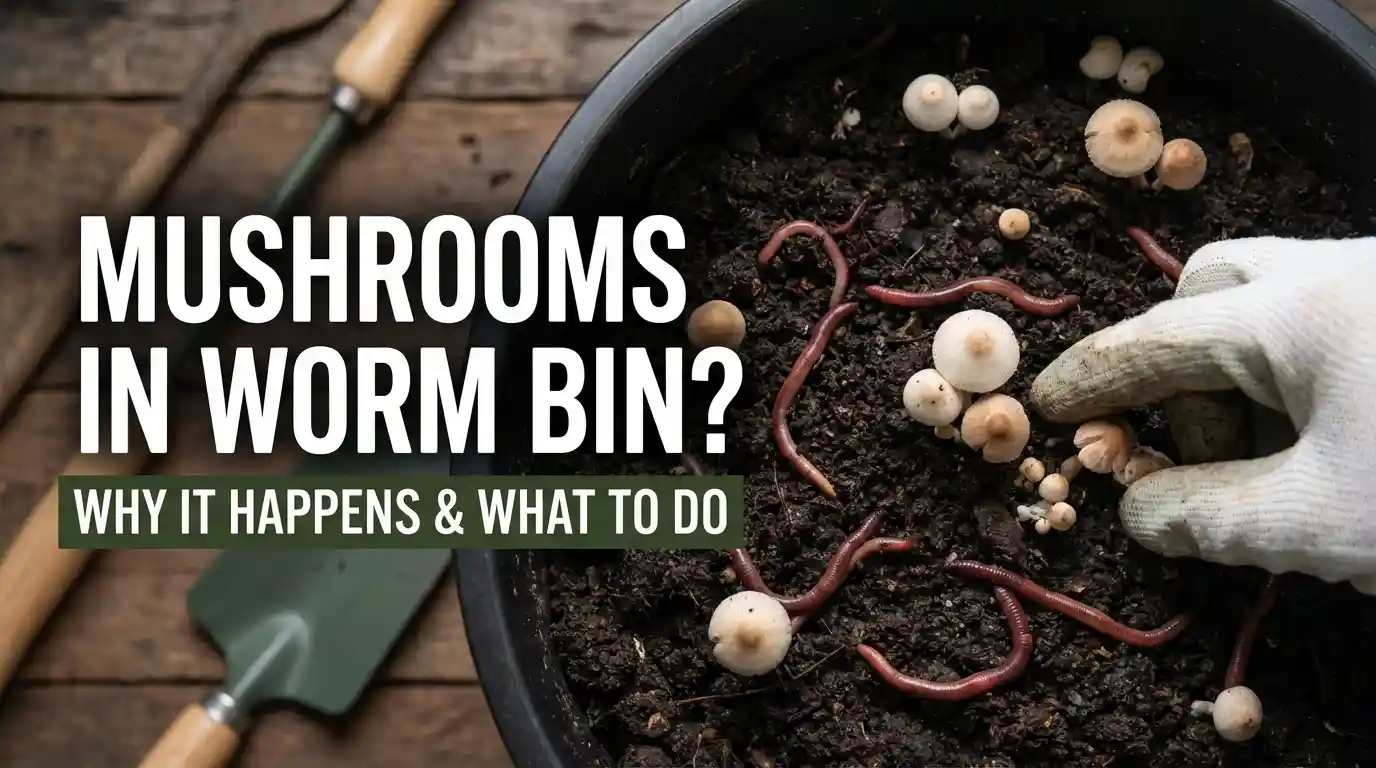

You open the lid to feed your Red Wigglers, expecting to see the usual mix of damp cardboard and coffee grounds. Instead, you are greeted by an entire miniature forest of mushrooms sprouting right out of the bedding.
Sometimes they are tiny, pale white ink caps. Often, they are vibrant, neon-yellow umbrellas.
If your first reaction is to panic, grab a trash bag, and assume your entire bin has been contaminated by toxic spores – stop! Put the trash bag down.
Seeing mushrooms growing in your worm bin is an incredibly common phenomenon. It does not mean your bin is ruined, and it does not mean your worms are in danger.
In fact, the presence of these fungi tells you a lot about the microscopic ecosystem you are building. Let’s break down exactly why mushrooms are crashing your compost party, whether you should be worried, and how to manage them.
The Short Answer: Are Mushrooms Bad for Worms?
No. Mushrooms are completely harmless to composting worms. Earthworms and fungi have been best friends in the soil for millions of years. Worms do not have teeth; they rely on bacteria, microbes, and fungi to soften and break down organic matter before they can swallow it.
When you see a mushroom, you are only seeing the “fruit” of the fungus. Beneath the surface, the fungus has spread a network of white, thread-like roots called mycelium. This mycelium is actively breaking down tough carbon (like your shredded cardboard and newspaper), turning it into a soft, mushy feast for your Red Wigglers.
Why Did Mushrooms Suddenly Appear?
Mushrooms don’t appear by magic. The spores were already there, but they require a “perfect storm” of three specific environmental triggers to sprout. If you have mushrooms, your bin currently has:
1. High Moisture (The Swamp Factor)
Fungi require extremely high humidity to produce a mushroom cap. If your bin is dripping wet or condensation is heavily coating the walls and lid, the environment is mimicking a damp forest floor after a rainstorm.
2. High Carbon (The Buffet)
Mushrooms feed heavily on decaying woody materials. If you recently added a massive layer of thick cardboard, dry autumn leaves, or wood chips to your bin, you have provided the ultimate fungal buffet.
3. Stagnant Airflow
Mushrooms love still, humid air. If your bin’s lid is snapped shut tight and the ventilation holes are clogged or insufficient, the trapped, warm moisture creates an ideal incubation chamber.
The Most Common Culprit: The Yellow Houseplant Mushroom
If the mushrooms in your bin are a shocking, bright neon yellow, you are looking at Leucocoprinus birnbaumii.
This specific fungus is famous for popping up in indoor potted plants and warm compost bins.
- Where did it come from? The spores likely hitched a ride on store-bought potting soil you threw in, or they blew in through an open window and landed on your kitchen scraps before you tossed them in the bin.
- Is it toxic? This species carries medium-severity poison characteristics and can cause serious stomach upset if eaten by humans or pets. However, it is 100% safe for your worms. They will eventually eat the decaying mycelium.
5-Minute Fix: How to Control the Fungal Forest
While the mushrooms won’t hurt your worms, their presence is a loud warning sign that your bin is too wet. If left unchecked, that excessive moisture will eventually drown your worms or turn the bin anaerobic (smelly and sour).
It can also cause your worms to ball up on the surface — a stress response that signals the environment has become hostile.
If you ever notice that happening alongside the mushrooms, this guide on why Red Wigglers clump together will help you diagnose whether it’s a panic situation or something harmless.
Here is how to safely evict the mushrooms and rebalance the bin:
Step 1: Pluck the Intruders
Put on a pair of gloves (especially if you have the yellow mushrooms) and simply pluck the visible mushroom caps at the base. Throw them in your outdoor trash or an outdoor compost pile. Do not dig aggressively to remove the underground white mycelium—you will stress the worms, and the mycelium is actually beneficial.
Step 2: The “Dry Cap” Method
You need to absorb the standing humidity. Add a 3-to-4-inch layer of completely dry, shredded cardboard or newspaper to the very top of the bin. Do not spray it with water. Let this dry layer act as a sponge to wick the excess moisture out of the lower bedding.
Not all dry materials perform equally well here – if you want to know exactly which bedding types absorb moisture best and how to prepare them, this complete guide to making worm bedding at home covers the right materials, blends, and the all-important moisture test.
Step 3: Crack the Lid
Airflow is the enemy of mushroom growth. If you are using a plastic tote, leave the lid propped open by half an inch for the next 48 hours. The fresh oxygen will dry out the surface and stop new mushrooms from forming.
Step 4: Pause the Scraps
Stop feeding your worms any high-water-content foods (like watermelon rinds, cucumber peels, or tomatoes) for at least one week. Force the worms to eat the existing bedding while the moisture levels drop.
FAQ: Fungi and Worm Bins
“Will the mushrooms spread to my house?” No. Unless you are dumping your worm compost directly onto your living room carpet, the spores have nowhere to go. They require damp soil and decaying wood to grow. Your dry household environment is perfectly safe.
“My bedding is covered in white fuzz. Is that a mushroom?” White, spiderweb-like fuzz spreading across your food scraps is usually mold or the mycelium of a fungus. Just like the mushrooms, this is a healthy, natural part of the decomposition process. If it turns green or black, simply cover it with more dry cardboard to suppress the spores.
“Can I feed store-bought mushrooms to my worms?” Yes! Red Wigglers love leftover culinary mushrooms (like portobellos or button mushrooms). Just bury them deep in the bedding so they don’t attract fruit flies.
Summary: Embrace the Fungi (But Watch the Water)
Finding mushrooms in your worm bin is a sign that you have created a rich, biologically active ecosystem. The fungi are working with your worms to turn your trash into black gold.
However, use them as an environmental gauge. Pluck the caps, add a thick layer of dry browns, and increase your airflow. A balanced bin will still have beneficial fungi working beneath the surface, but it won’t be wet enough to sprout a forest on top!

Leave a Comment